
UK Manufactured · 100% Non-Corrosive
The Smarter Alternative to Stainless Steel Rebar
Bastech BFRP rebar is 100% non-corrosive, 4× lighter, and significantly more cost-effective than stainless steel — engineered from volcanic basalt rock for structures that last over 100 years.
- Corrosion rate
- 0%
- Weight compared with steel
- 4×
- Design lifespan
- 100+
The Problem
Stainless Steel Rebar Is Over-Specified and Over-Priced
For decades, engineers have defaulted to stainless steel rebar in corrosive environments. It works — but at 3–6× the cost of Bastech Basalt rebar, with significant weight penalties and ongoing concerns about chloride-induced pitting in extreme conditions.
Excessive cost
Stainless steel rebar costs 3–6× more than Bastech Basalt rebar. On large infrastructure projects, this adds hundreds of thousands to the budget — often unnecessarily.
Unnecessary weight
At ~7,850 kg/m³, stainless steel adds enormous dead load to structures. This increases foundation costs, transport costs, and installation complexity.
Still not immune
Stainless steel resists corrosion — but it's not immune. In highly aggressive chloride environments (coastal splash zones, de-icing salt exposure), pitting corrosion still occurs.
Head-to-Head
Stainless Steel Rebar vs Bastech BFRP Rebar
A direct comparison across every metric that matters for corrosion-resistant reinforcement in concrete structures.
| Property | Stainless Steel Rebar | Bastech BFRP Rebar |
|---|---|---|
| Corrosion resistance | Resistant (not immune) | 100% non-corrosive — zero rust, ever |
| Density | ~7,850 kg/m³ | ~1,900 kg/m³ (4× lighter) |
| Cost vs carbon steel | 3–6× higher | Significantly lower than stainless |
| Tensile strength | 500–700 MPa | ≥1,000 MPa |
| Thermal conductivity | High (thermal bridging) | Low — improves insulation |
| Electromagnetic | Conductive | Transparent — ideal for MRI, radar |
| Chemical resistance | Limited in extreme pH | Excellent in acids, alkalis, saltwater |
| Design lifespan | 75–100 years | 100+ years (no degradation) |
| Sustainability | High-energy production | Single-melt from volcanic rock, low carbon |
| Installation | Heavy — requires cranes | Lightweight — manual handling possible |
Advantages
Why Engineers Are Switching to BFRP
Six compelling reasons to specify Bastech basalt FRP rebar instead of stainless steel reinforcement.
Absolute Corrosion Immunity
Unlike stainless steel which resists corrosion, BFRP is completely non-metallic. It cannot corrode — period. No pitting, no crevice corrosion, no stress corrosion cracking. Ever.
4× Lighter Than Steel
At ~1,900 kg/m³ vs ~7,850 kg/m³, BFRP dramatically reduces dead load. Smaller foundations, easier transport, faster installation. One worker can carry what previously needed a crane.
Significant Cost Savings
BFRP rebar costs substantially less than stainless steel while delivering superior corrosion performance. Factor in reduced transport and installation costs, and the savings multiply.
Zero Thermal Bridging
Low thermal conductivity eliminates the thermal bridging problem inherent in all metal reinforcement. This improves building energy efficiency and reduces condensation risk.
Electromagnetically Transparent
BFRP is non-conductive and non-magnetic — critical for MRI facilities, radar installations, telecommunications infrastructure, and sensitive electronic environments.
Genuinely Sustainable
Manufactured from volcanic basalt rock in a single-melt process using only 5 kWh/kg. No hazardous chemical additives. No boron oxide. Just rock, heat, and fibre.
Technical Data
Bastech BFRP Rebar Specifications
Typical properties of Bastech basalt FRP rebar, produced by pultrusion with epoxy resin at our UK facility in Leighton Buzzard.
| Property | Value |
|---|---|
| Diameter | 4–32 mm |
| Length | Up to 12 m (Ø up to 8 mm also in coils of 50–100 m) |
| Tensile strength | 1,200–1,400 MPa |
| Modulus of elasticity | 50,000–55,000 MPa |
| Density | 2 g/cm³ |
| Thermal conductivity | < 0.46 W/(m·K) |
| Elongation at break | 2.5% |
| Electrical conductivity | Dielectric (non-conductive) |
| Magnetic properties | Non-magnetic |
| Corrosion and chemical resistance | Very high |
| Heat stability | Up to 300 °C |
Typical values for guidance only. Confirm project-specific design values with Bastech's engineering team. Equivalents to A393 fabric can be supplied in different lengths. UK stock available; prices ex works Leighton Buzzard.
Standards & design guidance
- ISO 10406-1:2008 — Bastech BFRP rebars are manufactured to meet this standard: Fibre-reinforced polymer (FRP) reinforcement of concrete – Test methods – Part 1: FRP bars and grids.
- ACI 440.1R — guide for the design and construction of structural concrete reinforced with FRP bars.
- BBA accreditation — currently in progress.
Full product range, including basalt mesh, geogrid and fibre: Bastech basalt FRP rebar product page.
Applications
Where BFRP Outperforms Stainless Steel
Every environment where stainless steel rebar is currently specified is a candidate for Bastech BFRP — at lower cost and superior performance.
Coastal & Marine Structures
Sea walls, harbours, jetties, piers, and coastal defences where saltwater spray and splash zones destroy conventional reinforcement.
Bridges & Highways
Bridge decks, parapets, and highway barriers exposed to de-icing salts. BFRP eliminates the primary cause of bridge deterioration.
Water & Wastewater
Treatment plants, reservoirs, and sewage infrastructure where aggressive chemicals and moisture create extreme corrosion conditions.
Car Parks & Basements
Multi-storey car parks and underground structures exposed to chlorides from vehicle tyres and de-icing salt contamination.
Nuclear & Sensitive Facilities
Non-magnetic and electromagnetically transparent — essential for MRI suites, data centres, radar installations, and nuclear containment.
Tunnels & Underground
Rail and road tunnels where moisture ingress, ground chemicals, and limited maintenance access make corrosion-free reinforcement critical.

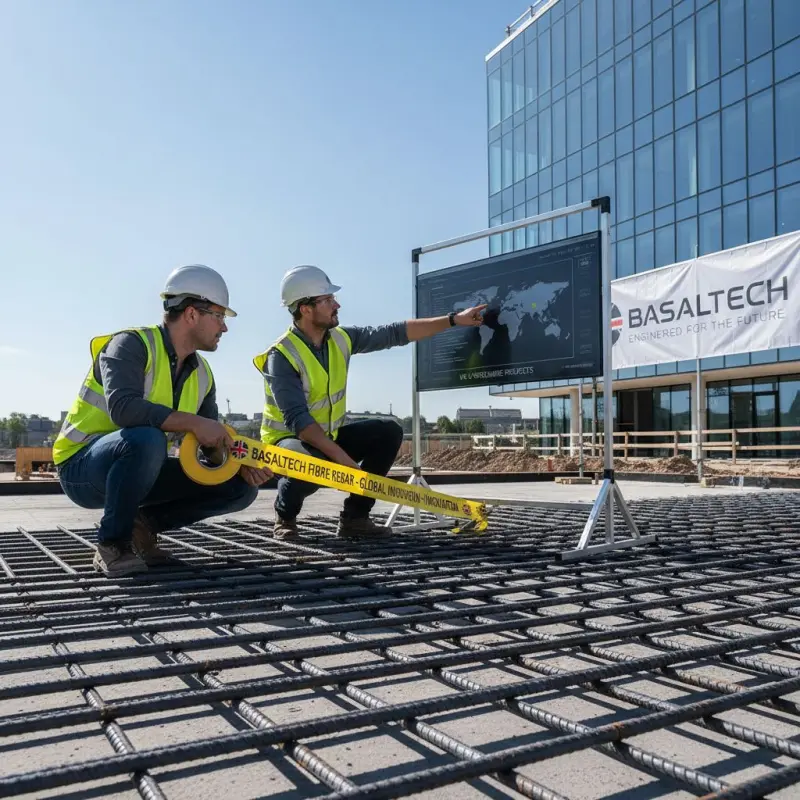
Bastech BFRP rebar on site — lightweight, non-corrosive, and ready for the future of construction.
Track Record
Completed UK Projects Using Bastech Basalt Rebar
Bastech BFRP rebar has been supplied to coastal, port and water infrastructure across the UK.
Canvey Shoreline Project Thames 2100
Flood and coastal defence · Canvey Island, Essex
Portsmouth Southsea Scheme Sub Frontage Replacement
Coastal defence · Southsea, Portsmouth
Lydd Rangers Seawall Road
Sea wall · Lydd, Kent
AB Ports
Port infrastructure
Dalmarnock Waste Water Treatment Works
Water & wastewater · Dalmarnock, Glasgow
Par Dock
Harbour & marine · Par, Cornwall
Need project references for your specification? Ask our engineers.
About Bastech
20+ Years of Basalt Fibre Expertise
Bastech was founded in 2015 to bring advanced basalt fibre technology to the global construction industry. We operate from our UK facility in Leighton Buzzard, manufacturing BFRP rebar and downstream composites with proprietary technology refined over two decades.
In 2020, we signed an EPC contract to design and build a complete basalt fibre plant in Fujairah, UAE for Arab Mining Company — commissioned in 2025 and now operated by Arab Basalt Fiber Company. Bastech Basalt rebars were used in construction of the facility. We retain the IP and engineering expertise behind the world's most advanced basalt fibre production facilities.
Completed projects in the UK include: Canvey Shoreline Project Thames 2100, Portsmouth Southsea Scheme Sub Frontage Replacement, Lydd Rangers Seawall Road, AB Ports, Dalmarnock Waste Water Treatment Works, Par Dock and many others.
FAQ
Frequently Asked Questions
Common questions about switching from stainless steel rebar to Bastech BFRP reinforcement.
What is BFRP rebar and how does it compare to stainless steel rebar?
BFRP (Basalt Fibre Reinforced Polymer) rebar is a non-metallic reinforcement made from volcanic basalt rock. Unlike stainless steel rebar which resists corrosion, BFRP is 100% non-corrosive — it physically cannot rust or degrade from chlorides, acids, or alkalis. It is also 4× lighter and significantly more cost-effective than stainless steel.
Is basalt FRP rebar an approved alternative to stainless steel rebar?
Yes. BFRP rebar is recognised by multiple international standards including ISO 10406-1, ACI 440, and CSA S807. In the UK, it can be specified under BS 8666 guidance for non-metallic reinforcement. Many highway authorities and infrastructure clients now accept BFRP as a direct replacement for stainless steel in corrosive environments.
What is the lifespan of basalt FRP rebar?
BFRP rebar has a design life exceeding 100 years. Because it cannot corrode, there is no degradation mechanism — unlike stainless steel which can still suffer pitting corrosion in extreme chloride environments over long periods.
Where should I use BFRP rebar instead of stainless steel?
Anywhere stainless steel rebar is currently specified for corrosion resistance: coastal and marine structures, bridges, tunnels, car parks, water treatment facilities, basements, and any structure exposed to de-icing salts or aggressive chemicals. BFRP is also ideal for electromagnetically sensitive environments like MRI suites and data centres.
How much does BFRP rebar cost compared to stainless steel rebar?
BFRP rebar is significantly less expensive than stainless steel rebar (which typically costs 3–6× more than carbon steel). When you factor in reduced transport costs (4× lighter), faster installation (no cranes needed), and zero maintenance over the structure's life, the total cost savings are substantial.
Can BFRP rebar be used in structural applications?
Absolutely. BFRP rebar has a tensile strength exceeding 1,000 MPa — higher than most stainless steel grades. It is used in structural slabs, walls, foundations, and beams. Design guidance is available through ACI 440.1R and other international codes.
Is basalt rebar environmentally friendly?
Yes. Basalt fibre is manufactured from volcanic rock in a single-melt process using only 5 kWh/kg of electricity. There are no hazardous chemical additives — unlike glass fibre production which requires boron oxide. The raw material is abundant, natural, and the production process has a significantly lower carbon footprint than steel manufacturing.
Who manufactures BFRP rebar in the UK?
Bastech (Basalt Technologies UK Limited) manufactures BFRP rebar at our facility in Leighton Buzzard, Bedfordshire. Founded in 2015, our team has over 20 years of continuous basalt fibre manufacturing experience and has built basalt fibre plants internationally, including a facility in the UAE.
Get in Touch
Request a BFRP Rebar Quote
Tell us about your project and we'll provide a detailed quotation showing how Bastech BFRP rebar can replace stainless steel reinforcement — with better performance at lower cost.
- Free technical consultationOur engineers will review your specification
- Detailed cost comparisonBFRP vs stainless steel for your project
- CPD presentations availableWe can present to your engineering team
- Tel: +44 7789 551966
- Email: info@basalt.tech